Review of "Toward an Architecture"
A great epoch has begun. There exists a new spirit. There exists a mass of work conceived in the new spirit, it is to be met with particularly in industrial production. Architecture is stifled by custom. The "styles" are a lie. Style is a unity of principle animating all the work of an epoch, the result of a state of mind which has its own special character. Our own epoch is determining, day by day, its own style. Our eyes, unhappily, are unable yet to discern it.
Toward an Architecture is Le Corbusier's 1923 manifesto, written as a set of loosely connected essays. He makes several overarching points (here quickly summarized):
-
The industrial revolution has brought new technologies and societal demands, and new architecture must respond to meet the moment. If it doesn't, social unrest will follow.
Entire cities have to be constructed, or reconstructed, in order to provide a minimum of comfort, for if this is delayed too long, there may be a disturbance of the balance of society. (p 101)
-
Architects are preoccupied with imitative "styles" of the past which are decorative and superficial, and not derived from these new conditions.
Architects live and move within the narrow limits of academic acquirements and in ignorance of new ways of building, and they are quite willing that their conceptions should remain at doves kissing one another[…] (p 92)
-
In contrast, engineered industrial objects have a pure aesthetic without explicitly caring about "architecture". They define and solve a problem, and by solving it exactly, they create something beautiful.
Nobody to-day can deny the æsthetic which is disengaging itself from the creations of modern industry. More and more buildings and machines are growing up, in which the proportions, the play of their masses and the materials used are of such a kind that many of them are real works of art, for they are based on "number," that is to say, on order. Now, the specialized persons who make up the world of industry and business and who live, therefore, in this virile atmosphere where indubitably lovely works are created, will tell themselves that they are far removed from any æsthetic activity. They are wrong, for they are among the most active creators of contemporary æsthetics. Neither artists nor business men take this into account. It is in general artistic production that the style of an epoch is found and not, as is too often supposed, in certain productions of an ornamental kind, mere superfluities which overload the system of thought which alone furnishes the elements of a style. Grotto-work does not make Louis Quinze, the lotus is not the Egyptian style, etc., etc. (p 89)
-
Architecture manifests through 3 characteristics — mass, surface, and plan.
a. Mass is the platonic forms which make up the shape of a building
b. Surface envelopes and reinforces the underlying form. It should not be clad in
c. The plan determines the mass and surface.
This book affirms many ideas I've believed to be true — ideas that I likely unknowingly absorbed as regurgitations of Le Corbusier's original points. It's difficult to understate Le Corbusier's influence on modern architecture, and by reading this it became clear to me just how influential he was. I almost feel like I spoiled the book for myself by learning some of these points before I read it, because they're so satisfying and profound. Yet Le Corbusier still expresses them so well that I enjoyed reading it anyway.
His main point is that the "engineer's aesthetic" is closer to a true style than the fanciful historicism of his day. He highlights boring, industrial objects like grain elevators, turbines, and steamships. It's an uncomfortable and offensive truth that styles are not "invented" ex nihilo, but forged out of mundane constraints. Le Corbusier's brilliance was in leaning into the new industrial age instead of rebelling against it, and I can only imagine what the reaction to his writing at the time was. It's easier to snub these ideas and continue focusing on the "high art" of rocaille or pilasters or whatever.
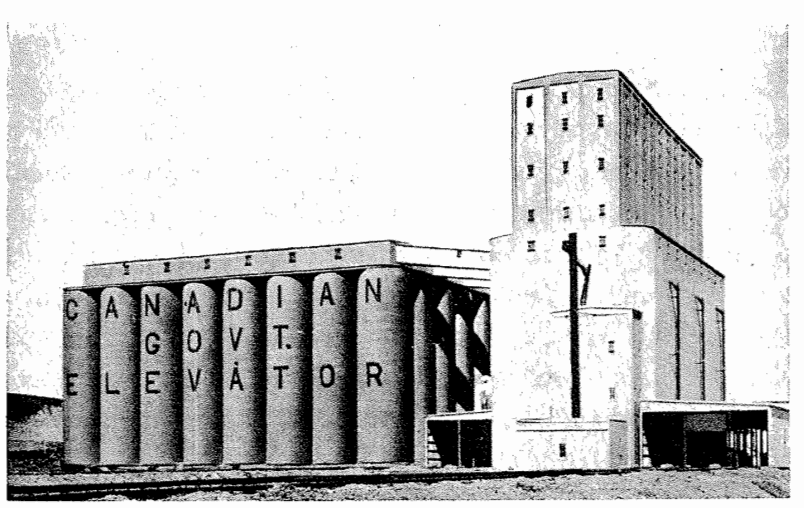
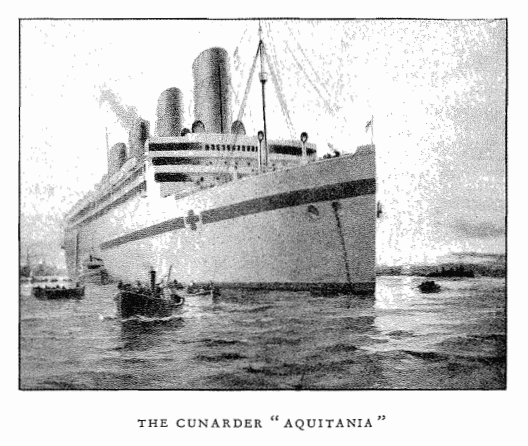
Although written directly in response to its moment in history, this point is timeless. Surface-level fascination with historical styles — whether classical, or even modernist ones that Le Corbusier influenced himself — is misguided.
There was recent discourse sparked by Tyler Cowen and Patrick Collison's call for "New Aesthetics". I saw a lot of lazy, retro-futurist suggestions. More interestingly, I noticed a few people suggesting styles that grasp on to what it means to be "human" in the age of AI (link). This impulse reads like the same architects who clutched onto their fanciful ornamental styles and scorned industrial objects. When a new style emerges, it will embrace contemporary problems and technologies. (i.e. AI, although it's still unclear how this affects physical construction. The industrial revolution's impact on construction was obvious and direct. Plus, Le Corbusier wrote his manifesto in 1923, a few decades after the industrial revolution came into focus; AI is practically less than a decade old, and the new styles it will create are still unclear. New aesthetics are more apparent in digital design and visual art.)
Closer but still missing the point, some suggested that new styles could not be consciously "RFQ'ed", any attempt to search for them is misguided and self-indulgent, and that they simply emerge incidentally, like the automobiles and steamships did (link link link). Le Corbusier would object to this too — he recognizes these engineered designs as inspiration but was not so reductive to say that functionalism is enough.
One commonplace among Architects (the younger ones): the construction must be shown. Another commonplace amongst them : when a thing responds to a need, it is beautiful. But.... To show the construction is all very well for an Arts and Crafts student who is anxious to prove his ability. The Almighty has clearly shown our wrists and our ankles, but there remains all the rest ! When a thing responds to a need, it is not beautiful; it satisfies all one part of our mind, the primary part, without which there is no possibility of richer satisfactions ; let us recover the right order of events. Architecture has another meaning and other ends to pursue than showing construction and responding to needs (and by "needs" I mean utility, comfort and practical arrangement). ARCHITECTURE is the art above all others which achieves a state of platonic grandeur, mathematical order, speculation, the perception of the harmony which lies in emotional relationships. This is the AIM of architecture. (p 110)
Le Corbusier carves out a separate purpose for "architecture" as an art which elevates these functional forms. Interestingly, he seems to shun ornament completely and instead argues that architects should achieve this art solely by arrangement of the primary forms (by planning mass and surface), calling it a "plastic art".
Architecture is the masterly, correct and magnificent play of masses brought together in light. Our eyes are made to see forms in light ; light and shade reveal these forms ; cubes, cones, spheres, cylinders or pyramids are the great primary forms which light reveals to advantage (p 29)
Finally, it will be a delight to talk of ARCHITECTURE after so many grain-stores, workshops, machines and sky-scrapers. ARCHITECTURE is a thing of art, a phenomenon of the emotions, lying outside questions of construction and beyond them. The purpose of construction is TO MAKE THINGS HOLD TOGETHER ; of architecture TO MOVE US. (p 19)
I agree that form is the primary concern, but his distaste for ornament is too extreme. If anything beyond basic constraints are left to the architect, then why is ornament not a valid (even if minor) way to elevate it? Ornament doesn't have to be a cop-out for poor consideration of form, it can accentuate it. He even devolves into racist arguments against ornament (likely picked from Adolf Loos' infamous essay Ornament and Crime).
Decoration is of a sensorial and elementary order, as is colour, and is suited to simple races, peasants and savages. Harmony and proportion incite the intellectual faculties and arrest the man of culture. The peasant loves ornament and decorates his walls. The civilized man wears a well-cut suit and is the owner of easel pictures and books. (p 143)
His prescience was far-reaching but limited too. He spends an entire chapter talking about mass-producing houses. A century later, this idea has still not panned out. The chapter almost reads like a bold business plan for a construction business. He advocates for an entirely new system for housing construction, relying on mass-produced components and techniques to standardize parts and reduce costs. Architects could then use these standardized components to create beautiful homes.
It necessitates a minute study of every detail connected with the house, and a close search for a standard, that is for a type. When this type has been created, we are already at the gates of beauty (of. the motor-car, the liner, the lorry, the airplane). (p 264)
He makes an interesting analogy to the Parthenon, which he argued only came as the result of a long process of standardization of Greek columns.
The Parthenon is a product of selection applied to an established standard. Already for a century the Greek temple had been standardized in all its parts. (p 133)
Housing is this kind of third-rail subject in both design and economics; people seem to have all these superstitions and mental blocks that prevent them from thinking about it like any other domain. In fact, this was what Le Corbusier was trying to warn against:
Everybody, quite rightly, dreams of sheltering himself in a sure and permanent home of his own. This dream, because it is impossible in the existing state of things, is deemed incapable of realization and so provokes an actual state of sentimental hysteria ; to build one's own house is very much like making one's will. (p 263)
In 100 years, not much has changed. I suspect the reason is not that mass-produced housing is ugly, soulless, and undesirable, but that either political inertia or economic challenges have prevented it from coming to fruition. (I don't know much about the subject though.)
This also reminds me of "democratized luxury" products like iPhones. Billionaires don't use a different phone than you and I; technology has standardized and lowered the cost to the point where money can't buy a better experience than the one you get for $999. I still have trouble wrapping my head around the concept that housing could end up like this, but maybe I just have a bad imagination. If good, standardized housing existed, I might want it — who knows.
In my last review I discussed Robert Venturi's Complexity and Contradiction in Architecture, which was written primarily as a reaction to Le Corbusier and modernism. Venturi is a more thorough writer, but Le Corbusier has a much greater grasp of what design entails. Venturi's arguments are mostly reactionary (he dislikes modernism's over-simplicity) and superficial (about perception rather than the innate reasons for beauty).
There are a few similarities between their philosophies though. Both architects celebrate mundane vernacular objects, but for different reasons. Le Corbusier appreciates manufactured objects for their incidental beauty, whereas Venturi appreciates them only for their symbolism.
I'd recommend this book to anyone. It's a quick read, and it's broadly applicable beyond architecture.
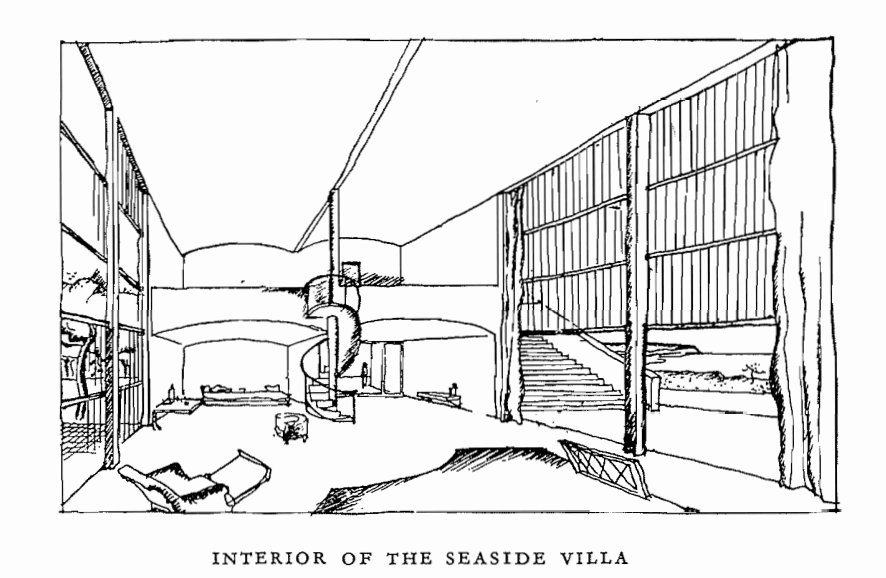
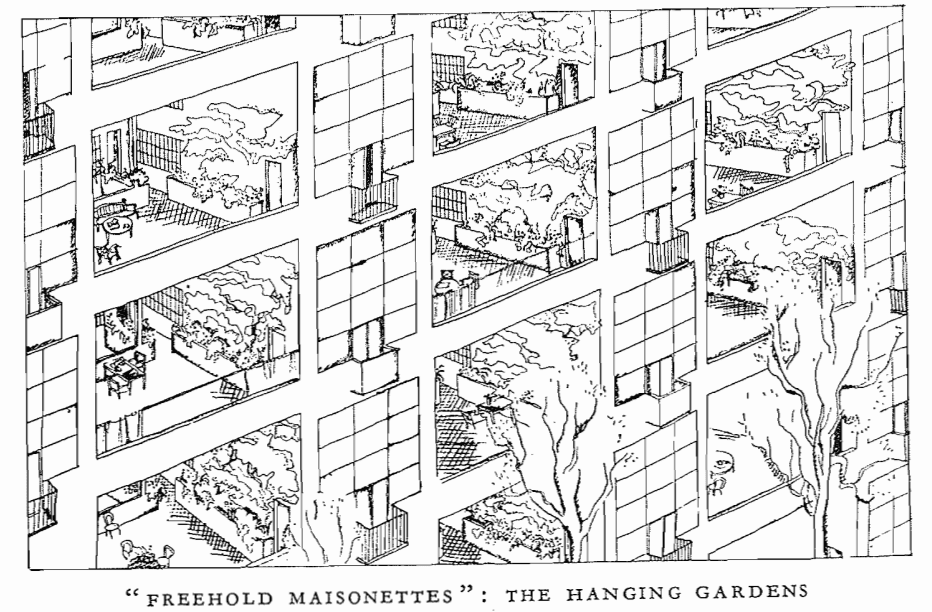
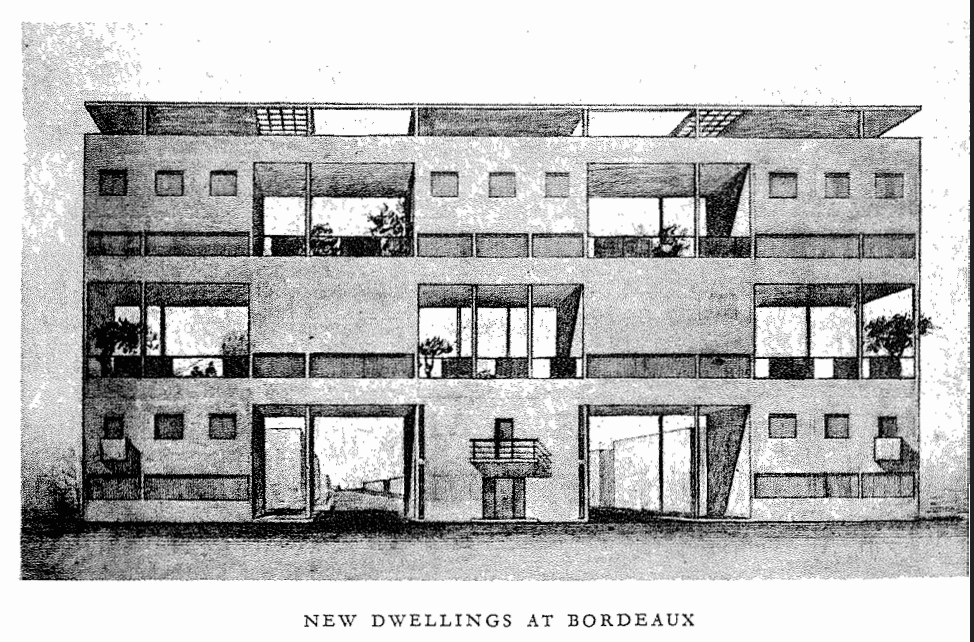
A few other quotes I like:
The truth is that man has an uncanny faculty of adapting himself to new conditions. He learns to admit and even, in a sneaking sort of way, to like new and strange forms. The new form is at first repugnant, but if it has any real vitality and justification it becomes a friend. The merely fantastic soon dies.
The modern engineer, then, pursues function first and form second, but it is difficult for him to avoid results that are plastically good. The good modern painter pursues plastic form for its own sake, and if be has the necessary ability the results are plastically satisfying. (p viii)
Gothic architecture is not, fundamentally, based on spheres, cones and cylinders. Only the nave is an expression of a simple form, but of a complex geometry of the second order (intersecting arches). It is for that reason that a cathedral is not very beautiful and that we search in it for compensations of a subjective kind outside plastic art. A cathedral interests us as the ingenious solution of a difficult problem, but a problem of which the postulates have been badly stated because they do not proceed from the great primary forms. The cathedral is not a plastic work; it is a drama; a fight against the force of gravity, which is a sensation of a sentimental nature.