Blinded by the Box
I love the idea of markets not only for consumer products, but as consumer products in themselves, and I’ve built a few apps on that premise. Evidently, there is no bigger manifestation of this right now than trading cards.
A friend sent me an interesting PDF last week — “THE BLINDBOXIFICATION OF EVERYTHING” by Josh Luber. It’s about the evolution of the trading card market, its current dynamics, and how its distribution methods (namely blind boxes) are diffusing into other areas of consumer goods.
The author’s overarching thesis is that the trading card product has become more about the “game” of chasing cards — buying and ripping packs and reselling — than about owning the end product itself.
Without even really trying, brands have created a world where capture (consumption) is incidental; where possession isn’t the point; where all that matters is the experience of the hunt.
The market is the product. Interesting! This is exactly the kind of thing I should be excited about, yet I finished the essay with the opposite reaction. The specific dynamics Josh describes strike me as unstable, and some of the analysis drawn from them seems backwards. I don’t mean this in a moral sense — i.e. lamenting the convergence of commerce and gambling [1] — I just came away from the piece feeling concerned for the state of the industry. If the sports card product has become the game of hunting hits, then my goal is to examine that game’s economy in detail.
I don’t expect anyone to read the full essay before reading my post (it’s long); I’ll pick out specific parts that I disagree with, and you’re welcome to go back and read the original material if you find it interesting.
Finally, let me preface by saying that I have a lot of respect for the author (Josh previously co-founded StockX and Fanatics Collectibles). I was a big sneakerhead growing up, and I remember Campless before it was StockX. Thinking back on it now, StockX’s insight of treating sentimental consumer products as real assets with serious market mechanisms was probably very formative in shaping my interests. Something clicked in my brain the day I figured out what an order book was by trying to buy Jordan 5s.
Problems
Luber describes the evolution of the collectible hobby as moving from disinterested ownership to hits chasing.
Yeah, sure: there are still young kids who enjoy the simple game. They love to collect for the sake of collecting, and they treasure their little binders full of hometown hero base cards. Bless their little cards.
It’s no longer about collecting for its own sake, it’s about ripping packs. And because individual packs are so unlikely to deliver big hits, a new synthetic product has emerged — the “repack” — in which third-party sellers tune their own blind-box packs to whatever your budget and risk appetite is. If you want a 1% chance at a $1,000 card, you can buy it for $10. If you want a 10% chance of a $1,000 card, you can buy it for $100. Even better, you can rip digital repacks from your phone and immediately sell back the cards you pull (for 90% of their value), without taking physical delivery of your inventory.
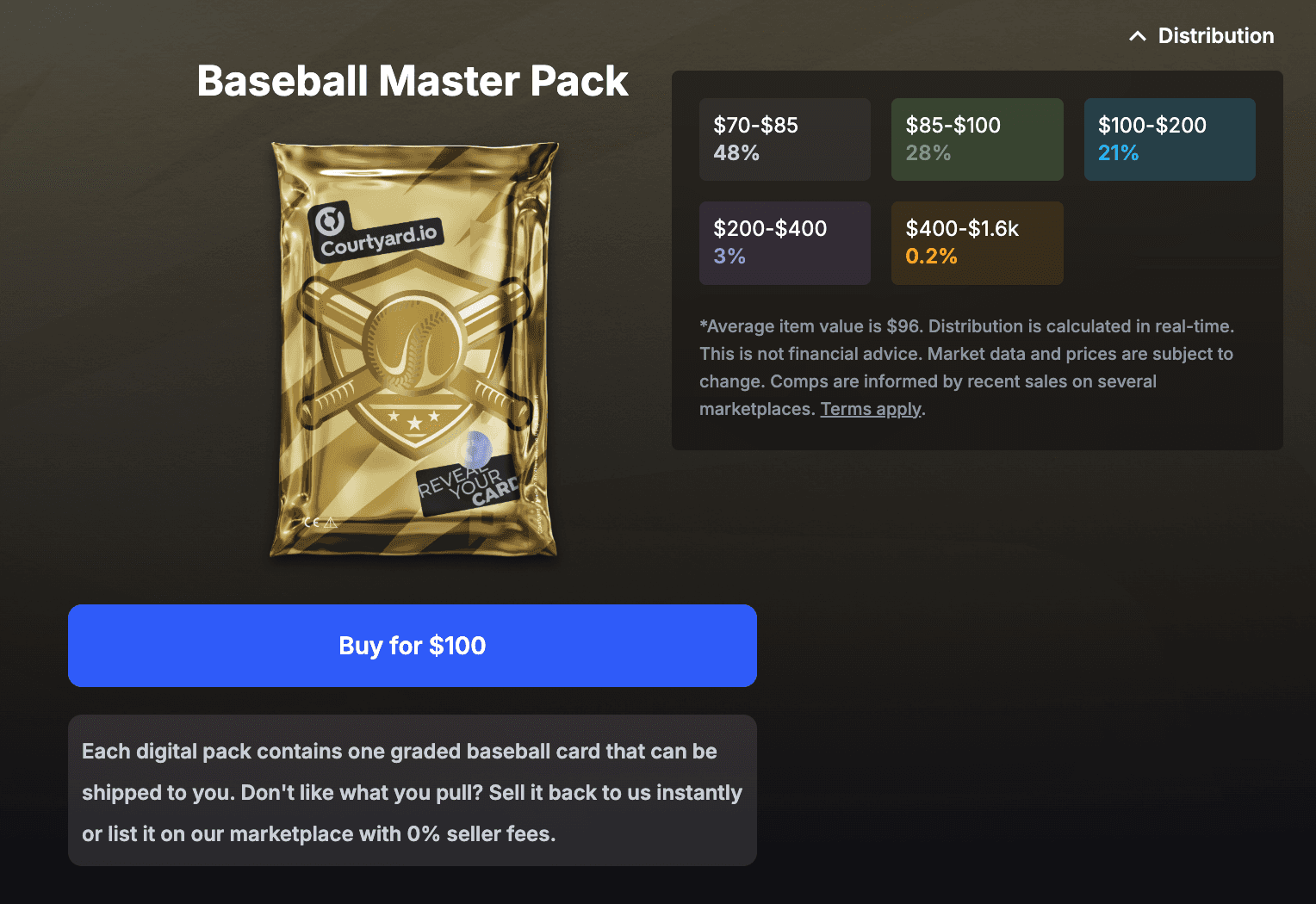
In the evolved form of the “Hobby” [2], the point is the thrill of chasing rare cards, not actually owning them. Even hits aren’t worth owning, he says — they just get sold back into the market as collectors search out an even rarer catch.
In a repack product, that card might be treated as a HIT, but will the lucky owner sell it back, or keep it? And if they’re not keeping it, what are they keeping?
They’re only keeping the absolute rarest, most inaccessible cards — “truly collectible cards” (TCCs) as he calls them. TCCs are the linchpin upon which the entire industry value chain rests. Luber predicts, “In the future, the only HITS that will appreciate in value - the only ones with real collector/investor demand - will be TCCs. All other HITS will become poker chips.”
This is simply not a healthy market structure.
Repacks are a casino (even if Josh thinks otherwise [3]), but more importantly, they’re a casino where the chips are speculative assets. Luber even notes that repack providers are driving much of the demand for individual cards, so increasing repack demand drives up the prices of individual cards (“singles”) in turn, which drives up the FMV of cards that repackers issue and buy back from users.
The repack business model doesn’t necessarily depend on asset price inflation; it’s a volume play. If you can buy a card for $1,000 and sell it 100 times, buying it back each time for 90% of its value, you make $10,000. Repackers, then, are more like market makers than fundamental investors. They still take considerably more risk than casinos though, and the 10% buyback discount is partially compensation for this risk (otherwise the buyback would be closer to 100% of FMV).
The problem is that the FMVs that repacks rely on are increasingly driven by their own products’ demand, not by collector-led price discovery. If price benchmarks are increasingly set by hollow transactions for gamblers cashing in their chips, rather than discerning collectors valuing cards on their own merits, then the price becomes a fragile signal.
There are four sources of demand in the market:
| Demand Source | Motivation | Price Sensitivity |
|---|---|---|
| Repack companies | Buy because you need inventory to sell packs | Low |
| Gamblers (Repack users) | Buy at current valuations because of the fun of hitting big [4] | Low |
| Collectors | Buy because you want to own the card | Medium-High |
| Speculators | Buy because someone else will buy for higher | High |
Market makers trade stocks with all investors, some of whom are flipping coins, but some of whom are buying & selling based on their fundamental view of the underlying business. The latter category is the important one, because it provides a real external anchor for the price. Sports cards are losing that anchor [5].
There are a few ways things might unwind: maybe consumers get tired of ripping packs that never hit, or regulators enforce age restrictions, or fewer collectors want to buy at prevailing comps. In any case, repack volume drops, and the largest buyer on the singles market all of a sudden isn’t buying as much. Note that repackers can adjust their pack prices and odds to accommodate card price drops (e.g. pay $100 $50 for a 10% chance at a $1000 $500 card), but a markdown on inventory still hurts their business.
Notably, unlike previous collectible market crashes (e.g. the Junk Wax Era, in which manufacturers flooded the market with cards), I don’t think it takes a supply-side blunder to crash the market. Topps can continue carefully curating scarcity, but that doesn’t prevent consumers from reevaluating their demand for it.
Luber doesn’t see this as a problem — he thinks the house can always print more chips to keep the casino running.
The value of the chips will always remain relatively stable. There will always be new rookies and prospects - new HITS and FILLER pulled from new wax. So if the value of the old chips degrades too much (because the 90% buyback velocity gets too high), the casino can always restock with new ones.
This is fantastical thinking [6]. If most cards end up deteriorating in value, simply issuing new ones won’t undo the damaged consumer sentiment that led to the original cards’ devaluation. Consumers aren’t entirely rational — maybe they’re allured by the chance of a new rookie becoming the next Ohtani — but the author and I both understand that prices are real signals and you can’t fool the market indefinitely. If consumers come to expect that most hits will become worthless, then hit prices fall across the board — not just old cards!
Josh is correct that most cards become worthless, but incorrect about the mechanism by which that happens. He thinks that assets slowly depreciate and retire in an orderly fashion as new inventory takes their place; I expect all of them to reprice downward at around the same time.
The underlying illness is that nearly all of the demand for this product is driven by extrinsic incentives. The disinterested collectors that the author patronizes are ironically the solid fundamental demand on which The Hobby was built, and that foundation is now languishing as the industry Goodharts GMV.
The most important lesson (the only lesson?) from crypto was that when products wire financial incentives too tightly into the core experience, it short-circuits user behavior, crowding out motivation for the underlying use case. You want collectors to care about owning mid-range hits, to treasure their binders and show off cards in their Zoom backgrounds, even if they aren’t TCCs. I don’t disagree that the chase is a large part of the experience, but it can’t be the entire experience. The game of ripping packs and hunting hits is no doubt a lucrative amplifier for the sports card product, but it’s better to think of it as a meta layer, not the core game.
It’s kind of sad, too. Sports cards could be such a cool product! I can think of so many ways to build engagement around this synthetic memorabilia format, but all we have is dumb vanity cardboard. It’s also why I’m excited about digital platforms like Real Sports. Real is a social sports app with a unique take on collectibles — they make cards for individual moments like plays and performances, rather than just players. Their cards feed back into an entire in-app economy with meta-games, progression, and novel distribution methods (for example, getting a chance to pull the card for the game-winning shot right after that game ends) [7]. The downside is that nothing beats the tangibility of physical collectibles.
Then why is the market booming?
I have the unfair benefit of hindsight, in that I’m writing my essay 6 months after “THE BLINDBOXIFICATION OF EVERYTHING” was published. But in that time frame, the card market has only gotten crazier, as the dynamics Josh described continue to intensify.
That the market experienced two booms so close together is peculiar. It skyrocketed in 2021-2022, crashed, and is now rebounding even more strongly in 2025-2026.
Just for fun, let’s overlay this on the S&P:
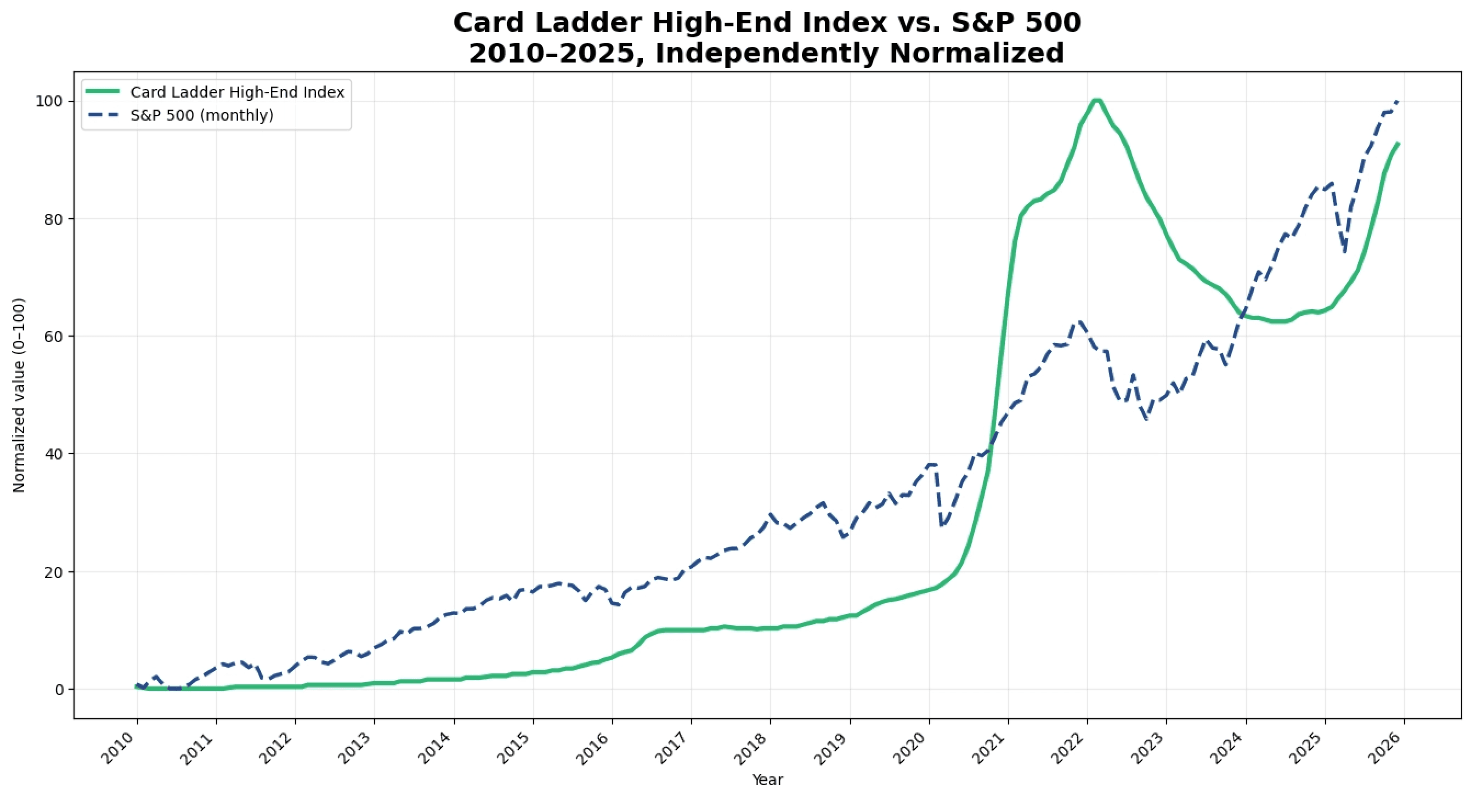
The timing is…hard to ignore. A great deal of ink has been spilled on whether we’re in an AI bubble, but not quite as much on the derivative consumer-sentiment manias which have nothing to do with the underlying reason that the economy is growing, except that people want to get richer because seemingly everyone around them is getting richer. You can point toward microeconomic catalysts within the card industry (which Luber does a great job of analyzing) driving these peaks, but they don’t explain the timing in the same way that the macro picture does.
On the micro side, the rise of repacks and the normalization of gambling are no doubt major drivers of the 2026 boom. It’s possible that the destigmatization of gambling is a secular trend, and that in our post-scarcity-AGI-UBI future, we’ll be content to wager our stimulus checks on unregulated blind box repack rips, Labubu futures, and six-leg Kalshi combos. But even if gambling is here to stay, that doesn’t imply gambling on cards is. Casinos are a durable business, even if they’re -EV, because the proposition is always the same: stake $X to win $Y. Cards make a great substrate on which to build a casino because they’re cool and culturally relevant. The cultural substrate provides a premium over boring old cash, and provides narrative cover to users who don’t think (or don’t want to admit) they’re gambling. But if that substrate loses its cultural cachet, then it ceases to make for a good casino chip, and customers can take their action elsewhere.
Another phenomenon driving the boom: entertainment products have cycles and supercycles. Successful toys enjoy an initial 1–3-year era of popularity before starting to fade. If, however, a toy can survive beyond that long enough, there comes a second generational cycle, which can often be much bigger than the original. Why? The kids who originally enjoyed that product are now adults who have kids of their own (or at least money of their own).
- If they have kids, they want their children to share the same cultural experiences that they had growing up.
- Even if not, they want to buy the rare cards they could never get their hands on. [“Kidults”]
I think we’re partially seeing the effects of this. ‘90s kids who grew up with Pokémon or Junk Wax-era sports cards are now adults surging back into the hobby to feed their nostalgia [8].
TCCs
Not all scarcity is created equal.
I define organic scarcity to be anything that is physically constrained by the player or moment itself. There is only one 50/50 home run ball. In contrast, synthetic scarcity is deliberate and arbitrary; Topps can conjure up a 1/1 card at the snap of a finger [9].
Just because a card is officially licensed and depicts a specific player doesn’t mean that its value is fundamentally linked to the popularity of that player. It’s quite possible that card prices decouple from player popularity if buyers don’t recognize synthetically scarce memorabilia as a genuine artifact of a player’s greatness. Synthetic scarcity is fragile.
I’ve written in the past that scarcity is only meaningful in context, and issuers of scarce items need consumers to buy into that context for their scarcity to mean anything. If Topps wants their synthetically scarce cards to hold value, the onus is on them to aggressively build and preserve the narrative that their products represent culturally lasting memorabilia. I don’t think they’re doing nearly enough on that front.
Pokémon
If you only look at the marketplace, you’d get the impression that Pokémon card dynamics look a lot like sports cards. Closer inspection reveals that the specifics of their product strategy are quite different. Pokémon owns and controls their IP (so by definition, every card is synthetically scarce), and the world of Pokémon IP is beloved and immersive.
Unlike sports, where cards are referential artifacts of events and athletes that exist in real life, there is no distinction between Pokémon IP and product. The card instantiation of Charizard is not merely a souvenir of a character that lives somewhere else: the card game is a primary medium through which Pokémon builds its world. Pokémon Trading Card Game (TCG) director Atsushi Nagashima describes crafting stories directly into the sets they release:
One recent set, Breakthrough, involved the story of two parallel worlds split apart by time, each with its own Mewtwo. “There was a Mewtwo that was in this advanced world, this really advanced civilization, and there was a Mewtwo that was in this more old-fashioned or old-timey world,” Nagashima says. “And these two worlds collide and the world goes into chaos and is destroyed as a result of that.” [10]
This is a subtle point, but I think it helps explain why Pokémon treats its card product the way it does. Sports are a wonderful source of IP because they’re so unpredictable; Topps can nearly take for granted that new moments will supply them with sought-after cards. Because Pokémon must build their world from scratch, they care deeply about the product experiences that bring their characters to life [11].
People actually play Pokémon TCG, giving the cards a source of utility beyond simply owning and collecting them [12]. Interestingly, The Pokémon Company seems actively averse to the financialization of their products. Their packs have no bounded scarcity (no 1/1s), and they try to limit speculative resale activity at their events.
The sports card business is a case study in distributionmaxxing. The number of distribution innovations that have come out of this industry is dizzying, but the underlying product remains relatively tame. Despite what Luber argues in “THE BLINDBOXIFICATION OF EVERYTHING,” I think it’s a dangerous misclassification to treat these innovations as the actual product.
I’d love to see more emphasis on the content side, but not just in new parallels and inserts: meta-games for collectors, collector paraphernalia, digital-physical crossover experiences — more reasons to own cards even if they aren’t financially valuable.
Footnotes
[1] Though I do feel a moral aversion to it ↩
[2] Card collectors often refer to the hobby literally as “The Hobby.” I don’t know why. ↩
[3] The author presents the argument that collectibles are not gambling because the value of what’s at stake is dependent on scarcity — it’s not fixed monetary value. He then presents a misleading thought experiment about a lottery offering every other ticket to win either a) $1M, or b) a rare Ohtani card. He implies that these lotteries are not functionally equivalent, because the Ohtani card's value is dependent on it being rare, and diluting the supply of the card destroys the $1M value.
Given that cards have market prices, repacks are clearly gambling; the source of that price is immaterial. If you can stake some money for a chance to win a card, instantly convertible to cash, then there is legitimately zero functional difference between that and a slot machine.
What are we doing here? What's going on? ↩
[4] Repack users do not represent traditional demand for single cards, but you can think of them as buying a weighted basket of cards. Hypothetically, if a repacker offered a pack with a 100% chance of a card, that is indistinguishable from offering that card directly. ↩
[5] I am not making the argument that stocks have inherent value in a way that collectibles don’t — even non-cash-flowing assets can have value — but collectible value is more cultural and fickle. ↩
[6] I feel like I just read something like the SBF magic box moment.
https://youtu.be/KZYqL79GDXU?si=FbNc4RAdA074RiMR&t=1294 ↩
[7] I know Topps has this too (Topps Now), but it's just not the same as doing it from within the same app that you’re following the game from. The value of digital products is in these immediate engagement loops; having to go to a separate website to buy a card that arrives days later is not as compelling. ↩
[8] The same generational cycle partially drove the ‘90s boom, as OG collectors from the ‘60s wanted to share the hobby with their kids. Josh wrote about this in his 2021 essay. ↩
[9] Accidentally scarce cards such as the T-206 and 1952 Mickey Mantle fall somewhat outside this distinction. They weren’t intentionally scarce, but their scarcity doesn’t relate to any play or moment from their respective players’ careers.
Inserts bring organic scarcity into synthetically scarce cards. You could say that this is less valuable than just buying the entire jersey, but there is definitely value in plugging relics into the standardized card format. The uniformity of the format is a key part of why cards work as a collectible. ↩
[10] https://gameinformer.com/2018/09/09/trade-secrets-the-making-of-a-pokemon-card?utm_source=chatgpt.com ↩
[11] It’s interesting to consider that Topps is the more vertically integrated company — they not only issue packs, but also own a secondary marketplace and a live shopping product. In some sense, though, Pokémon is more vertically integrated because they have full creative control over their IP.
This also speaks toward each company's incentives. Topps is positioned to capture value from secondary market sales; Pokémon isn’t. ↩
[12] Perhaps the reason why so many vintage cards are scarce is that kids actually used their cards to play the game, and many of those cards were lost or damaged. By the '90s, sports collectors were already aware of the importance of preservation and long-term value. ↩